
As the festive season draws ever closer I am using this opportunity to promote my book, Down The Garden Path- snippets from the Cottage Gardener.
As winter is now practically upon us I include some of the horticultural snippets that are most appropriate for that season. The book is of course available on Amazon but you can buy it direct from me at sammacdonald3@hotmail.com. Until the 14th of December I will be offering two copies for £15 instead of the standard price of £10 per book. As it is a slim volume it would make an excellent stocking-filler or as a light-hearted read for someone horticutural minded in front of the fire. Even if you aren’t interested please do share this link on facebook to anyone you think might be interested…
Also, do have a look (and like!) my facebook page http://www.facebook.com/claphamcottagegardener where I have recented posted some horticultural highlights of my time in Burgundy and The French and Italian rivieras…
Champagne and Ghost stories are closely linked to Christmas but there are few plants in flower except the slightly mythical Christmas rose. So I include an early January favourite, the snowdrop as one of my favourite plants not just from winter but from the whole year. I hope you enjoy…..
Champagne
The English wine industry has a bad reputation which is slowly improving. But apparently the best English wines are the sparkling white wines, a.k.a English champagne. This is because the chalk ridge that stretches over northern France goes through the channel and emerges on the south coast of England. In theory the terroir, which makes champagne so unique, is very similar to the south-eastern counties of England. In addition, the average temperature and rainfall are very similar. So why not?
Well, it’s all a matter of branding. The French make the best sparkling wine and we know that because everyone drinks Champagne at Christmas — if they can afford it. Otherwise they stay with the Continent and drink Prosecco! Even if English wines were as good, I don’t think people would drink them as a luxury item. This is because the best English wines are as expensive as Champagne but without the reputation of being a special treat.
This brings me onto a colleague who, every time he visited a certain client of mine, was paranoid that they thought he was eyeing up their bottles of champagne in the garage (which we walked through to access the garden).
Anyway, I’d popped out and left him to his own devices when compelled by his inner desires said to himself aloud, “I could really do with a glass of Moët right now!” That would not have been a problem had the owner not been in the garage doing some laundry at that very moment!
Snowdrops (Galanthus spp.)(from the chapter ‘Plants I’ve known and loved’)
The snowdrop ranks highly, in my humble opinion, as a flower that cheers you up. Probably because they come at such an improbable time of year (late January/ early February), it causes them to be so well thought of. Like a clump of primroses, there is a sort of innocence and spring freshness about them as they hang like dainty little bells just above the partially frozen ground.
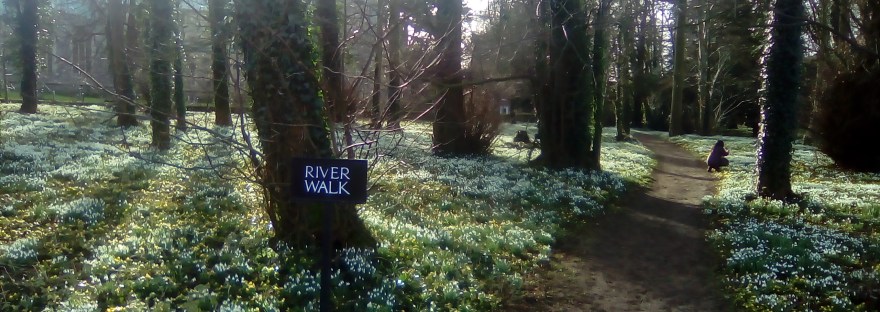
Galanthophilia takes this a bit too far though. I can´t get that excited about all the different types of snowdrops. Certainly not to the extent that I would pay £20 for a single bulb when they are a plentiful semi-wild plant. For example, at Walsingham Abbey Garden in Norfolk (between Wells and Fakenham) they have naturalized through acres of undulating woodland so it can look like a sea of white and tiny bells swaying gently in the breeze. This is because of the humus rich, constantly damp (but not waterlogged) soil which is slightly alkaline. They have spread so much because the conditions are presumably so similar to their native habitat of south-eastern Europe and Asia Minor. Although it has taken them hundreds of years to do so because they were probably originally planted as a symbol of Candlemas; which was a festival to commemorate the purification of the Virgin Mary after childbirth. It was celebrated on the 2nd of February, when religious symbolism was at its height, in Medieval times.
A Ghost Story for Christmas
My sister introduced me to M.R. James (whose ghost stories were turned into a series of short films as Christmas specials) in the ‘70’s and in the 2010’s. His stories struck a chord with me because many of the films are set on the North Norfolk coast which I know intimately. His haunting description of solitude, particularly when walking on an empty beach, is familiar to East Anglians in particular but not exclusively.
Here is my own attempt at a horticultural ghost story for Christmas.
De Wynter was a very queer man. He lived in the ruins of what had been the great Harpingdon Hall, a rambling house with turrets and chimneys originating from the 16th century. He had squandered his inheritance on booze and was frequently seen glugging a bottle of wine in the overgrown gardens of the hall. There was only one employee left called Williams and he slept in the woodshed because he had nowhere else to go.
One day, De Wynter was stumbling about the gardens when he tripped and fell into the remains of what had been a very fine yew walk. Once he had composed himself he saw Williams coming towards him and said, “Cut these bloody trees down you oaf! Can’t you see they’re getting in my way!”
Williams replied, “But sir, you can’t cut these trees down. It’s bad luck. We don’t want evil spirits haunting us!”
“That’s all rot! Fetch me an axe!”
“No sir, I will not. They say the Gipsies lay offerings under the ancient yew at the end there to appease evil spirits and I don’t intend to offend the spirits myself.”
“Damn your eyes, man. If I was paying you anything I’d sack you.”
He staggered to the end and looked quizzically at the posies the Gipsies had left of dog rose (Rosa canina), old man’s beard (Clematis vitalba) and wild geranium(Geranium pratense). He kicked childishly at the pile, grinding the posies into dirt, and stomped back to the hall. Williams, having seen all this, looked worried but said nothing.
That night a great wind blew from the west and the trees shook loudly and vociferously in the park. It was almost as though they were singing together some tragic song.
De Wynter suddenly awoke from his drunken slumber and heard the singing. He looked out the window and could see many lighted candles held by someone or something moving around at the bottom of the driveway. It scared De Wynter no end and he rang the bell. Williams eventually arrived and said, “It’s the gipsies, sir. They are unhappy about what you have done. You must make an offering to the ancient yew or we shall be cursed for all eternity!”
De Wynter took him more seriously this time. He said, “Alright man. Tomorrow I will do so but get these flaming gippos back to Gipsy Green or I’ll set the dogs on them.”
Williams said, “They won’t go sir. I have already tried.”
And so all night the wind howled and the sound of singing and lights haunted De Wynter’s soul.
In the morning Williams brought him his breakfast but he seemed struck dumb and could not speak a single word. And so it was that the Gipsies returned for three more nights and each night De Wynter grew more and more haunted until finally on the fourth day Williams arrived with his master’s breakfast to find him gone without trace.
And so it is said that De Wynter’s soul was taken by the tree and that no one should tread in the gardens of the hall at night in case they should meet De Wynter’s evil spirit.

 A gardener out of this world