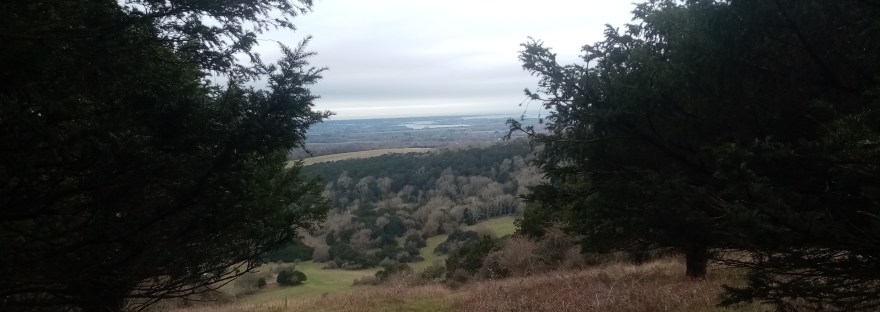
I have been visiting my Mum near Chichester and by chance discovered Kingley Vale nature reserve. It was a real eye opener to me because I was not aware that in the South-East some climax vegetation could be yew woodland. I was under the naieve impression that with the exception of a few areas where beech had taken a stronghold, such as in the Chilterns, oak was THE climax woodland here.
But at Kingley Vale this is not the case. On calcerous slopes yew can dominate sometimes replacing the relatively short-lived beech or simply adapting to the conditions from the start( I am sceptical of this but have no proof). I suspect there must have been some management during the last thousand years which has benefitted the yews especially given their status as a revered holy tree and of course their practical uses such as as longbows in archery.
Its an impressive sight to see them at a distance but almost more amazingly beneath the canopy, as though Tolkein’s necromancer had enchanted the forest, nothing grows under the trees except the poisonous dog’s mercury.
Infact, walking through the gnarled specimens is evocative of the feelings of enchantment conveyed by many woods in literature such as in Snow White or Hansel and Gretel.
Yew wood was much in demand in medieval times for archer’s longbows and arrows so the yew woods of Europe were much reduced so Kingley Vale is one of the biggest in Europe. Although to be honest it isn’t that big and much of the woodland in Europe, so I read, is mixed woodland containing some yew. There is also a yew plantation on the shores of Lock Lomond and in a few other sites in the North but it would seem that yew woodland is a horticultural delight of the South of England-hurrah!
The other interesting thing about yew trees is that they gradually hollow out so you cannot tell how old they are because the rings disappear. This creates some wildly optimistic guesses at the age of the trees and indeed it is often claimed that the yews at Kingley Vale were planted as a memorial for a battle between the Vikings and the Anglo-Saxons in the 9th century.
Whether it is haunted by dead Vikings and was the meeting place for druids is possible but in any case I won’t be cutting mistletoe with a golden sickle from the light of the moon there…..

 A gardener out of this world
Hello again. I was brought up near Chichester and my parents would take my sister and I up to Kingley Vale. The ground under the Yews on the climb to the top was slippery in winter but the view is worth the effort from the tumuli at the top.
LikeLiked by 1 person
Its a wonderful place. I visit as often as I can
LikeLiked by 1 person