Peter Melchett; member of the House of Lords and committed environmentalist but very much a man of people died in 2018. But his legacy lives on at his organic certified farm near Ringstead, North Norfolk.
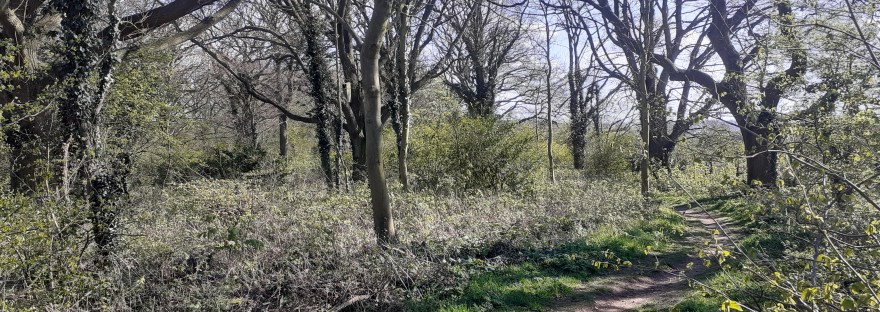
I had always marvelled at the fields of cowslips followed by ox-eye daises but had never paid much attention to the woods beyond. This is because you actually need to know what you are looking at to understand what they are trying to achieve otherwise you might put it down to lazy management. The signs they put up explained a good deal of their thinking such as leaving dead wood for fungi and invertebrates and an understorey of ivy and brambles(which is controlled so it does not get too thick) to provide cover for birds,reptiles and mammals.
Both the North wood and Wharton wood are managed under the Higher stewardship scheme (funded by the government) because this kind of ecologically managed wood is not profitable aside from the negligible cost of the hazel sticks that are harvested and used as fencing around the farm when the hazel is coppiced. Encouraging wildlife is important and it bears a relationship not only to our own wellbeing to live in a diverse habitat but also to sustainable farming, good soil fertility and sufficient birdlife to reduce pests without the need for pesticides….
I think I need to mention food webs here because in conventional, modern agriculture when you get an outbreak of aphids(for example) the crop is sprayed which means that the aphids’ natural predators such as ladybirds and blue tits have less food to eat. When combined with the destruction of the natural habitats of these predatory birds and insects (such as hedgerows, rough grass and woods) this means that when the next outbreak of aphids happens there are (again) not enough predators to reduce their numbers so that you are obliged to spray again. Its a self-perpetuating cycle and although organic agriculture does need to use pesticides in emergencies it can work if used intelligently such as on Courtyard farm (although with lower yields and a higher cost to food as a result). My reservations about Organic agriculture are purely based on the large, urban population of the world and its love of meat but that does not mean that it cannot be a niche market.
What I am trying to say is that the North Wood on Courtyard Farm is a wonderful work of ecology and my own subjective standard for judging that was how happy I felt in the spring sunshine strolling through the wood when it was alive with birdsong. This must be partly caused by their decision not to remove the ivy from the trees so that it can provide nesting and roosting sites as well as berries for birds in tandem with flowers for pollinators. Crucially ivy flowers and fruits at the coldest and most barren time of year so it’s contribution to bird numbers in particular is vital. But ofcourse they may lose a few trees in each winter because the weight of the ivy brings the tree down, which they admit on their information signs, but the diversity of the woodland is all the stronger for it…
Conventional thinking about brambles and ivy, or at least what I have read; is that they tend to create a monoculture where nothing else will grow. But although the woodland floor was not densely covered with primroses or other woodland plants such as foxgloves there was some germination of some other flora such as speedwell and ground ivy.
Some of the planting was a little disappointing, though. Although the rabbits and deer must be ruthless in their destruction of anything munchable the use of surburban shrubs such as cherry laurel, Berberis darwinii and Mahonia aquifolium was a little out of keeping with an English wood.
I would have liked to see more European woodlanders such as wild strawberries, lungwort, honeysuckle, foxgloves, snowdrops etc. But at least they had systematically removed 99% of the sycamore seedlings, that are not native, and a massive problem if left unchecked, whilst planting more oak and hazel.
But this is the choice they have made. If you have more cover for mammals, birds and reptiles then the opportunities for germination and growth of woodland flora are reduced and I respect that decision despite being inclined the other way. The most important thing to remember from a governmental point of view is that farms should not be treated like businesses where profit is the primary aim but as stewards of the countryside. It is a simple point but has been neglected since The Agricultural Act of 1947 made yield British farming’s primary objective. This aim has been rather too successfully met since the UK joined the EEC in 1973. With the end of EU membership it is time to consider what we the British people consider our priorities for agriculture in the 21st century and it’s a great but daunting opportunity.

 A gardener out of this world