I recently paid a visit to Winchester where I re-acquainted myself with the walk through Winchester College water meadows to The Hospital of St Cross. I half remembered the beautiful, ancient buildings at St Cross, its impressive gardens and the promise of ‘The Wayfarer’s Dole’ of ale and bread.
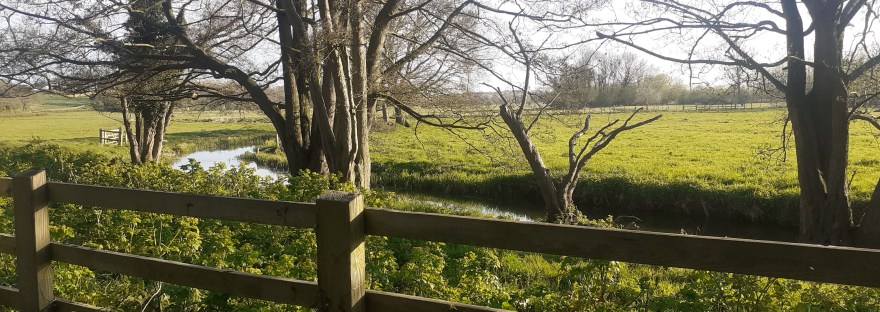
But in fact I never got as far as St Cross because I was so absorbed by the crystal clear water of the chalk stream that runs in a divided and haphazard way through the water meadows. Because it was autumn there were a number of plane tree leaves running down the stream, presumably from the inner courtyards of the college; whose mother trees I had half glimpsed whilst going past hoping; as Evelyn Waugh would say ‘to find that low door in the wall others had found before me which entered into an enchanted garden’.
The slow moving plane tree leaves in the clear water evoked in my mind that famous painting of Ophelia by Millais where she drifted down a river singing surrounded by bobbing flowers. The sun-lit waters on that late autumn day seemed to have the same magical quality to me.
The river also contained a number of small trout, a hungry-eyed heron and watercress but alas no kingfishers. I have always been aware of chalk streams, having recently happily strolled along the river Nar in Norfolk, but did not know that they are such a predominately English and indeed, endangered, habitat. It seems that about 85% of all chalk streams occur only in England. So they are; as the Government website points out, ‘Our Rainforests’. If we can’t look after them perhaps we ought to less moral in our attitude to Brazil and its deforestation.
Farming and domestic demand for cheap water perhaps represent the most serious threat to our chalk streams. The release of fertilizer, particularly from watercress farming, for which chalk stream water is the ideal growing medium is a particular problem. But also not stealing too much of its water for our own use(such as for domestic water systems or irrigation) so that the flora and fauna dependent on the river are not affected by the water table being too low, especially in summer.
It does seem strange to me that with such nationalistic overtones in English politics these days that the chalk stream and the soft Wessex like landscape it largely runs through (with its rich biodiversity) is not heralded as an ideal representation of Englishness which is being destroyed by immigration and the pressure it puts on the landscape. But then perhaps the Ukippers don’t have a ramblers’ club.
Kenneth Graham evoked that landscape for different reasons when he wrote The Wind in the Willows in 1908 partly because of the development and spread of Socialism(those horrible common stoats and weasels taking over Toad Hall is given as an allegory of this) and possibly because he saw the darkening clouds of war(hence Ratty’s determination to never go to the wide world but stay in the safety of the riverbank(England)).
But in any case the chalk stream is mentioned in much first rate English literature and poetry from Thomas Hardy to Wordsworth ‘How richly glows the waters, Before us tinged with evening hues…’ to Keats who wrote To Autumn after a walk along the River Itchen in Winchester one evening or indeed Rupert Brooke’s famous poem about the river near the Vicarage in Granchester(a few miles downriver from Cambridge).
Each poem beautifully describes the romantic qualities of water in chalk streams chiefly by emphasizing the ethereal effect of light on water. However, I think it is Tennyson who captured the essence of the chalk stream best when he wrote in The Miller’s Daughter-
I loved the brimming wave that swam
Thro’ quiet meadows round the mill,
……. Still hither thither idly sway’d
Like those long mosses in the stream.
Or from the bridge I lean’d to
……see the minnows everywhere
In crystal eddies glance and poise
The tall flag-flowers when they sprung…
Perhaps the final significant thing to say about the chalk stream is how it is intertwined with the art of fly fishing which does (from the outside at least) appear a deeply poetic and peaceful activity.
In the autumn I visited Stockbridge on the River Test which is a major centre of fly fishing and was excited to see quite a lot of large trout ‘grazing’ against the current in one of the streams running through the town.
If there weren’t huge restrictions on who can fish where and the expense of doing so then of course this wouldn’t be possible. Nevertheless it does sort of take the romance out of the activity of fishing if a young boy can’t just buy a cheap rod, skip school and spend a lazy afternoon fishing.
But investment in fishing and shooting by the elite (as a way of showing off whilst they play) is one route of preserving habitats that might otherwise be neglected. To be honest, anything that contributes to Britain being a cleaner, more sustainable and biodiverse place is fine by me especially if someone else is going to pay for it.
References-https://waterlightproject.org.uk/literature-chalk-streams/ (J.S Watts,2019)
Various articles from The Guardian and Scotsman

 A gardener out of this world
Interesting, poetic enjoyable blog.
LikeLike