More snippets from Spring 2019


Magdalen College Fritillaries

I saw a programme years ago about the water meadows of Magdalen College and half remembered it this April 2019 which is when the native snakes head fritillaries flower. I didn’t do much research so approached it from either side of the streams surrounding the college so I didn’t have to pay the £7 entrance. In fact I can tell you from bitter experience that Magdalen College is better fortified than a lot of castles because it is impossible to get to the water meadow without shinning up a drainpipe like a drunken undergraduate of yesteryear or getting impossibly wet. First, I crossed the bridge on the right hand side of the college as you approach it from the front and ended up in a park full of drunks and shady drug dealers. Despite this being the middle of the day I had to quickly retreat to prevent myself being relieved of my valuables. On the other side was an even more dodgy looking overgrown cemetery which looked the perfect spot for some gay camping. I have to say I can’t remember seeing so many undesirable characters in such a short space of time… maybe they pray on the Hooray Henrys and Cynthias after their first big nights in Oxford.

Eventually I arrived at the front desk and paid my admission fee whilst gently sweating. However, it was well worth it. Not only are the Great Hall, cloisters and chapel exceptionally beautiful but the grounds were immaculate. But the best bit was the water meadow which was chock full of fritillaries. There are so many that have self-sown that even from far away it did take my breath away. At the far end of the meadow you can sit and admire them from a bench with the backdrop of the spire of Magdalen College behind it- a remnant of Charles Ryder’s city of aquatint. As a side note to this the fellow’s garden is also a delight- full of spring flowers such as anemones, cow parsley and bluebells. Naturalistic planting is so much more conducive to free thinking in my humble opinion and the fellows of Magdalen College seem to agree!

Plant names-why do we need to know them?

My editor Katie Isbester asked me to come on her podcast for local businesses in Clapham. One of the questions she asked me was why we need to know the names of plants. I was flummoxed and outraged for a moment. Having spent so much time and effort learning the names of plants it had never occurred to me to ask the basic question of why it was so important to me as a gardener to have all this information.

It seems to me that there are two reasons- firstly we need to know the Linnaean Latin name so that we can identify and classify each plant in order to understand its uses and dangers to us as well as determining the best way to cultivate it in case it is commercially profitable. Secondly, as Richard Mabey argued based on the poetry of John Clare the common name gives us a romantic attachment to the plant such as in his description of the “wan-hued lady smocks that love to spring”. John Clare’s story is one of a true romantic. He walked some 90 miles from the asylum in which he was interred ,in Epping forest, to visit his childhood sweetheart in his beloved fenlands. He is quoted as saying  ‘I miss the heath, its yellow furze, molehills and rabbit tracks that lead through besom ling and teasel burrs that spread a wilderness indeed.’

 Robin Lane Fox echoed this sentiment in his book ‘Thoughtful gardening’ where he asked a student what the yellow flowers in the fellows garden outside his study were to which the student ( “with a career in high finance stamped all over her”) replied abruptly ‘I can see the same flowers as you I just don’t know their names!’. He seemed justifiably hurt by this outburst against the primrose which is perhaps the most charming of true wild flowers to have survived the industrialization of agriculture so bemoaned by John Clare.

A preview of Down the Garden Path- snippets from The Cottage Gardener

Transience

I met up with an old friend the other day who is more interested in fast cars and faster women than gardening(who can blame him?!?). He asked me what was the point of a wisteria when it only flowered for about 3 weeks. I thought he was trying to provoke me so I simply replied rather flippantly that yes we should pave over all gardens to save us the trouble of gardening for overly precious plants.

Of course what I really think is that the issue of transience is key here which the Japanese highlight in the way they immortalize the cherry tree’s progress through the seasons. Essentially, the beauty of a wisteria in full bloom is worth the effort for the rest of the year in the same way people never forget that first night where they danced all night with their first love. Both events are extremely beautiful and memorable but short-lived in their climax so to speak (but no less important for that). Kate Moss asked ‘Why can’t I have fun all the time?’ and indeed it would be fantastic if our lives were constantly full of love, interest and beauty. The reality for most of us , as you well know, is very different.


The Chalk stream


Chalk streams are incredibly special places to seek solitude in. The water is so clear and healthy looking and the sound it makes so soft that it creates an extremely appropriate atmosphere for a Sunday picnic. Also I always hope to catch a glimpse of a largeish brown trout drifting down the current because I always wanted to test the theory of Doc Spencer in the book Danny the Champion of the World that you could catch a trout by tickling them out of the stream…

I was fortunate enough to come across a beautiful woodland in Norfolk with a chalk stream meandering through it. Not only was the dappled shade and birdsong appealing but there were wild strawberries and raspberries growing abundantly for snacking on and plenty of foxgloves and honeysuckle clambering up the trees to appeal to my inner gardener.

There were very few people about even though the wood was very close to a busy A-road so I was able to lie down by the river in peace rather like you could at a Buddhist temple or indeed one of the nearby forgotten churches of North Norfolk.


The whingeing gardener


I used to work with a gardener who loved to have a good whinge about the work he was doing. He wasn’t lazy or incompetent he just couldn’t resist having a good bitch about something related to the job just as we were reaching the crucial stage of completing it.

As a result whenever I am doing a really shitty job (and I have done a few!) I think fondly of what he would say if we were pulling up brambles or tackling an oversized ivy on a scorching day in August.

There is a stretch of the road that connects the Docklands to the M11 which I rather think I would pay him to clear by hand if I had won the lottery. Not to help out the local community, you understand, but just to see the expression on his face as the cars rushed past this extremely long wall completely covered in a very well established ivy. No wonder he called me ‘Sadistic Sam’!

The Emerald Isle that is Dulwich

London is full of green spaces and perhaps we Londoners take them a little too much for granted. Here in Dulwich I can name 5 very different green spaces which are all very good whilst being walking distance from my house.

In fact when you look at Dulwich on the map it seems to be almost like the countryside which is a miracle given what the land is worth (rather like it’s more distinguished cousin Hampstead Heath!). If it was Spain half-built buildings would have mushroomed up all over the place…

Anyway here are my favourite green spaces in Dulwich-

1)One Tree Hill -where Queen Elizabeth might have danced naked under an oak tree and has a wonderful view of St Pauls! Its a steep climb from Brenchley Gardens or Honor Oak Park but well worth it. This is the only place where plane trees( Platanus x hispanica) are incorporated into woodland and there is also the parish church, cemetery and allotments (with a particularly friendly looking scarecrow near the gate).

2)Nunhead cemetery- which is a decaying Victorian cemetery(one of the Magnificient seven) and is now so overgrown with sycamores and ivy that it’s a nature reserve. Unfortunately, the cemetery was badly vandalized in the 70s so the chapel is just a shell but some of the clearings with Victorian angels staring skyward (with ivy twining under them) are impressive.

3) Peckham Rye Park- Includes a bowling green, Japanese garden, pergola garden and wildlife garden. Also the river Peck( which featured in Del boy’s fictional ‘Only Fools and Horses’) as the source for his bottled water, runs through it.

4) Dulwich Park- A typical Royal park with mature trees, Henry Moore sculptures,  wildflower meadow, mass plantings of  rhododendrons and large boating lake.

5) Dulwich woods- A large wooded areas with the remains of Victorian splendour such as a cedar of Lebanon, tennis courts reclaimed by nature and ruin. It also has a nature trail under the railway bridge where Pisarro painted his view of Lordship Lane railway station (which no longer exists, sadly). There are also various ponds and a good number of mature oaks as well as the interest of having an adjoining golf course, cricket pitch and allotments. Its so fantastic that this is one of my five favourite green spaces in London and is made all the more wonderful by the fact that is a small remnant of the ancient woodland called ‘The Great North Wood’ that ran from Deptford to Crystal Palace. I believe it was called this to distinguish it from the weald (or wood) , further south, in Kent and Sussex.

There are so many green spaces in Dulwich or indeed London that not all are marked. On Dunstans road there is a small green space called Dawson’s hill which runs up to the council estate on Ladlands hill( which probably has the best view in London). I know this not because I’ve been into one of the flats but because I’ve looked from the top of the park’s hill just below the flats and you get a full panorama from Canary Wharf in the east to the London Eye in the West. This is why there are suggestions that both the Romans and the Vikings used it as a fort to control the surrounding lands.

So lets remember the beauty of those things just around us before we jet off to the other side of the world….


I could definitely do without January!

There is no time more difficult as a gardener financially than January. The extravagances of Christmas are over and it is cold and dark and sometimes wet as well.

These conditions are not conducive to gardening and so the stream of work becomes a trickle. People rightly ask ‘ What do you do in the winter?’. Well I listen to MR James ghost stories, try to indulge my fantasy of being a gardening writer, spread manure on my allotment, empty my compost bin and walk on Hampstead Heath or in Richmond park. It would be quite pleasant if I was paid for it!

Having said that January is a time when you can prune wisteria and I do get some work doing that now although it doesn’t take long! Unfortunately I don’t know anyone with a wisteria walk or a 50 metre wisteria covered wall. To prune a wisteria you basically cut back all the long tendrils to 2 or 3 buds to encourage flowering in May. You should not touch any spurs unless they are dead, diseased or dying….

There are some horticultural highlights to look out for now. Cornus and Willow stems always look very cheerful in the January snow and Contorted hazels have produced their catkins by now. I am also very fond of the white birch (Betula utilis jacquemontii) and the sweet scent of Lonicera x purpusii.  Witchhazel can also look very impressive when in flower and smells wonderful.

But I think my favourite winter highlight is variegated ivy especially when it is covered in frost. My particular favourite is Hedera colchica ‘Dentata Variegata’. Look out for its startling lushness this January!

Discovering the flora and culture of Lake Bohinj, Slovenia

Having travelled overland by train from London I arrived in Lake Bohinj in late May. I had timed my arrival for the wild flower festival and as they love to say on Tripadvisor ‘boy was I not disappointed!’.

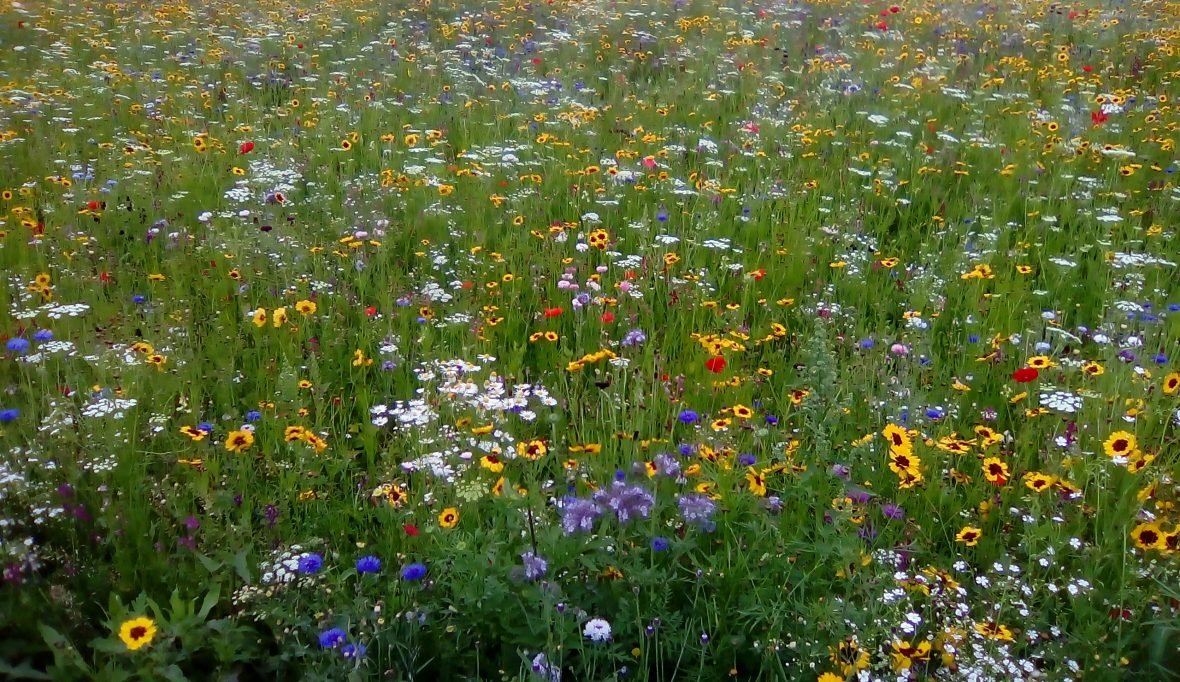
Not only were there a large number of wild flower meadows with a huge diversity of flora but they looked much more beautiful than any of our slightly more homogenous wild flower meadows here in Britain. Plants included ox-eye daisies, yellow rattle, clover, dianthus, Echium vulgare, common spotted orchids, buttercups and many others. The whole thing was done with so little effort (and so few signs!) that I felt completely at home.

There is a respect for nature in Lake Bohinj that I thoroughly approve of; like Italian food culture. They are farmers but they have not destroyed the habitats of native plants and insects in search of profit as we have done here in Britain. I could not comment in terms of how EU subsidies and government restrictions within the national park have effected this happy medium but it would be nice to see aspects of this system of management adopted in British national parks. The Yorkshire dales seems a particularly good place for this to occur because it has abundant rainfall and limestone like Lake Bohinj and is still relatively unspoilt.

I know I have already talked about the crystal clear water but really I could not believe how pure and blue it looked. Not having spent a great deal of time in Switzerland( Slovenia could perhaps be likened to Swiss alps but far cheaper!) I was amazed by the cows that wondered happily and peacefully round the lanes as though it was the Indian Himalayas. I think what made me feel very comfortable in Lake Bohinj, above all, was the people. Not everyone was friendly-I think the Slovenes are intially distrustful of people they do not know. But all the people in the wild flower festival were so pleased that I had come to see Lake Bohinj and went out of their way to give me any information I asked for about the plants, or indeed the general area.

But what really sold it for me was when I was a walk I took through one of the charming( but working) farming villages in the valley. I saw all the families sitting down to dinner, elbows flapping. It was so convivial and homely that I felt sad about how little chance families in Britain get to eat to together even on a Sunday.

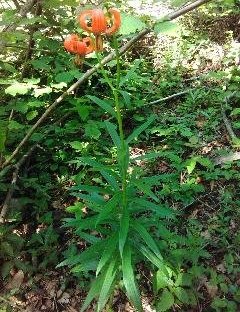
Having said all this not everything was perfect. We went up to Vogel, a meadow at the top of one of mountains and marvelled at the Carnolian Lilies. But we were brought down to earth by the remains of a bonfire in the meadow and the begonias used in the nearby mountain inn’s windowboxes. In fact, part of the amazement at the diversity of the flora is caused by the familarity of those plants because so many are used in British gardens.

Plants that stand out are Laburnums growing wild high up on the hillside, Solomon’s seal, Clematis alpina, a shrubby honeysuckle, Astrantia, Geranium phaem, Lamium orvala, Vinca minor(periwinkle), Hellebores and many types of Monkshood.

When I left to begin my volunteer placement in Croatia I was very sad to leave such an unspoilt and unique place. It reminds me that Europe’s strength is it’s diversity (set within a common culture) and if we lose that it will be a very sad day.