Almond trees
To show that I’m not a completely irrational tree-hugger I would say that I was never particularly fond of the almond tree that stood outside The Clocktower, my childhood home. It was a sickly thing and not easy to climb which was a significant point to a child obsessed with Just William who believed there are only 2 types of tree in the world- those that could be climbed and those that could not be climbed…
I can also not remember it flowering very well unlike the almond blossom with its background of rose tinted light captured in various Impressionist paintings that still inspire people to romanticize the South of France.
But ofcourse Almonds are much better suited to the Mediterranean climate found there and also in California which is now a centre for Almond production.
I was surprised to discover that Lubeck, a Hanseatic port of Northern Europe, with no almond production to my knowledge, has developed a reputation for producing top notch marzipan, including my personal favourite, Marzipan hot chocolate, consumed in the attractive cobbled square nearby.
Lubeck is a bit of a honeypot for tourists as it has managed to salvage the Hanseatic merchant houses from the machinations of the RAF. Hamburg ofcourse is beyond reproach in that regard but some Germans feel quite bitter about it when they see the dreaming spires of Oxford and Cambridge.
I was talking to the curate of St Mary’s church in Lubeck on this very subject and he described, in contrast to the horror of the war, the fact that his uncle James (an Englishman) was in a plane above Lubeck dropping ‘friendly’ bombs whilst his future wife was in the burning rubble of the town below as a prelude to their meeting and subsequent marriage. As is said in that great film Shawshank Redemption when the two lead actors meet again in the paradise of the Mexican Pacific coast ‘Hope is a good thing….perhaps the best of things…’
Not Much Room for a Mushroom
As I wrote in my first book I was very keen on foraging particularly for mushrooms in my younger days. This was inspired by the mushroom forays we went on in Thetford forest with the lengendary Peter Jordan, now sadly no longer with us. I learnt a lot and those walks filled with anticipation and excitement are still very clear in my mind even though they must have happened about 25 years ago now.
But such is the dulling influence of the supermarket aisle and lack of practice I have lost my confidence even when I heard that my godfather and his wife, Lif were having Karl Johannes(the Swedish word for Boletus) mushrooms again in East Yorkshire as a regular lunchtime treat. Lif used to grind the unused mushrooms into the lawn with her heel,when the mushrooms were beyond consumption, and it seemed to spread the spores sufficiently to keep the kitchen well supplied.
I think the final nail in the coffin so to speak, and fortunately it was not my coffin, was the recent incident when a woman served up Beef Wellington to her ex-husband’s family. Three of his relatives died after that meal whilst mysteriously she and her children survived unscathed which was a most suspicious set of circumstances given the acrimonious nature of their separation.
Rick Stein was always keen to point out how lacking in variety our diet is. A huge proportion of the world’s population is dependent on 3 crops; rice, wheat and maize. Yet there is so much variety and it is the same with the extent of the fungal kingdom, even if much of it is not edible, the diversity of species never ceases to amaze me.
For example, much like the horror film, Blood on the Devils Claw there is a species of mushroom that looks like claws emerging from a witches’ mushroom fungus and smells like rotting flesh to boot. It is called Clathrus archeri
Then there is the ghostly glow of the Jack o’ latern fungus (Omphalotus olearius) that does glow ‘Halloween Green’ in the dark although to the untrained eye, in the light, it can appear like chanterelles.
For those with a dentist phobia there are Hydnellum peckii mushrooms that resemble a tooth with drops of blood formed on it. I’m sure you are salivating at the prospect of these gastronomic delights just before you go out foraging yourself…..!
An English Gap Year
Leif Bersweden spent his gap year summer going round the British Isles trying to see every one of the 52 species of Orchid that grow there. It was a hugely inspirational book; well written and funny as well as being informative.
The most important point about it was that it showed that wonder, even in the natural world, can be found below our very feet if we really look instead of having such a jaded palate that only the most exotic and exciting experiences can tickle our imagination.
In comparison, you might choose another more famous book about orchids written by Tom Harte-Dyke about how he went to the Darien Gap in Panama to look for orchids and how he got kidnapped before eventually escaping. A great book to read but in no way more interesting than doing such a thing at home, however brightly coloured or beautiful those tropical orchids were.
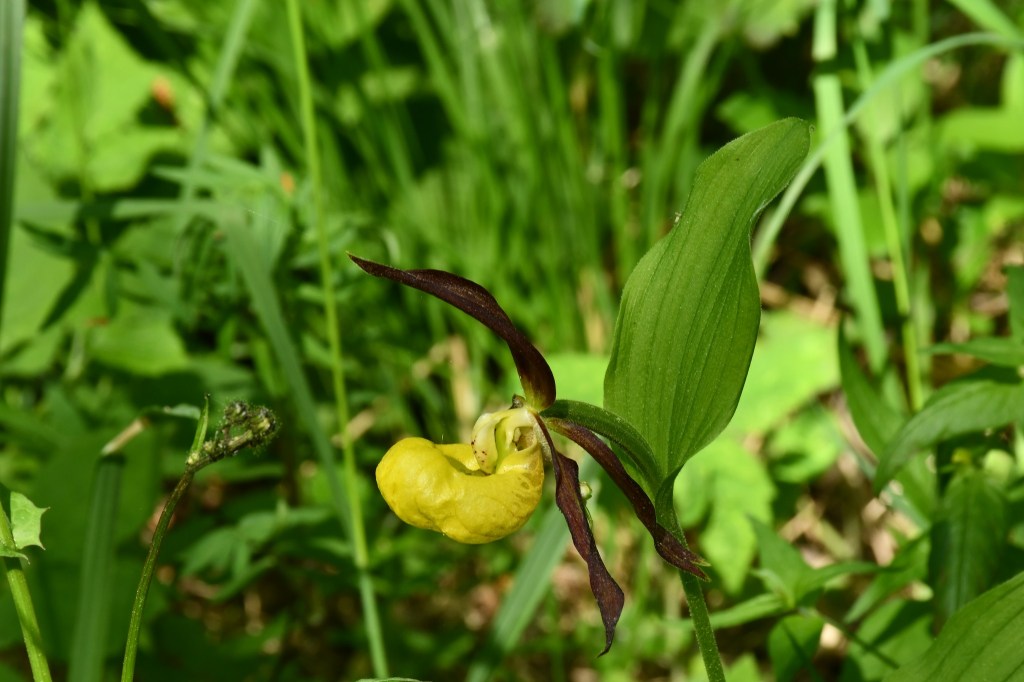
I was particularly excited by Bersweden’s description of the Lady’s slipper orchid (Cypripedium calceolus), saved from extinction by a group of stubborn Yorkshire naturalists when Victorian Orchidmania had stripped places were the Lady’s Slipper grows in Britain, such as the Yorkshire Dales bare. The plant was effectively put under decades of 24 hour surveillance in order to save it from pilfering hands.
The project has been quite successful as more plants have been raised from seed, encouraged to germinate by its tipple of Pineapple juice, so that it has been re- introduced to a few more sites in the North of England, whose lush grass, babbling brooks (although less so its nibbling sheep) make the perfect backdrop for such an exotic looking orchid which is red and yellow and not surprisingly in the shape of a slipper( picture at the beginning of the article- credit David Wilkinson). It also has an interesting pollination technique which looks carnivorous but is infact a way of forcing any pollinating insects to rub pollen off their backs at the entry to the flower.
Despite it being critically endangered in the British Isles the Lady’s Slipper’s cousin in Europe is more common. Nevertherless, it was with silent wonder, whilst visiting my friend known affectionately as Dodgy Dave in Estonia, that we entered a clearing in his woods near a small stream to find in all its glory a small colony of these orchids in full bloom. What’s more Dodgy Dave even kept his promise not to dig up the orchids to sell at the Sunday market in Tallinn or reveal their location so hopefully those orchids are alive and well.
 A gardener out of this world