I did not expect Knettishall Heath(KH) to differ greatly from other parts of Thetford Forest with its monoculture of pines and silence. But actually it is quite distinct and has a diverse mosaic of habitats from mixed woodland to riverside meadows to heathland, ofcourse.
The landscape as we see it now on Knettishall Heath is not natural. It was created by our ancestors in the Bronze age, about 4,000 years ago, through the early use of grazing animals and had changed very little until the advent of modern farming and forestry.
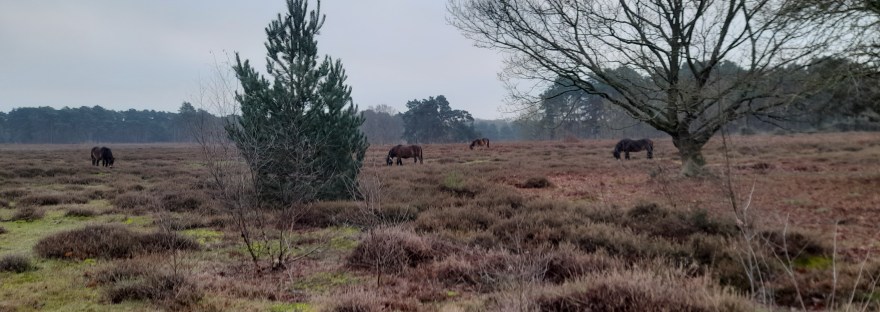
Nevertheless, KH represents our best chance of seeing what a Bronze Age landscape looked like as a direct result of the efforts of The Suffolk Wildlife Trust( and the local community) to restore the incursion of woodland during the 20th century. Exmoor ponies are extremely conspicuous on the heath and continue to prevent the colonisation of bracken and woodland.
This area of the Norfolk-Suffolk borders where KH is are known as the Brecks( or Breckland) and consists of a mixture of sandy and chalky soils liberally sprinkled with heather and Scots pines. Because of these soils the flora is very diverse offering plants indicative of either sandy or chalk soil. Furthermore, the habitat that is created by the climate and soil is of national significance with 12,500 species, 30% of which are nationally rare.
That being said, I did not get first hand experience of much wildlife mainly because it was the middle of winter. But the sight of Exmoor ponies munching on the vegetation in the mist was very poetic. A slice of the New Forest in Suffolk….
The other thing I really liked, as a walker, was that it is a junction of ley lines with the Icknield Way, Peddars Way and Angles Way all passing through it. The Icknield way apparently predates man’s existence and sweeps all the way to the Dorset coast whilst the Peddars Way is a Roman road leading to Holme-next-to-sea on the Norfolk coast where Roman soldiers would then take the ferry across the Wash and head onto Lincoln.
To illustrate its antiquity a Bronze Age burial mound can still just be seen here. Although it is a long way from being the best preserved site of that time!
A much later development that I also find quite interesting is that because the Brecks are so good for wild game, in the 18th century, rabbits were farmed in specially built rabbit warrens here which are again just visible.
I am not claiming the The Brecks are worth a special visit but if you are in the area you might be pleasantly surprised by what KH has to offer….

 A gardener out of this world
Just shows if you explore there is a reward and it was most interesting.
LikeLike