The Holy Water at Walsingham
The Holy mile from the Slipper chapel in Houghton St Giles in Norfolk to Walsingham is considered one of the holiest places in England. Indeed it is referred to as England’s Nazareth. Perversely it has been recorded that Henry viii walked it barefoot (as is the custom) plus an extra mile from East Barsham where interestingly there is a massive hall which presumably would have met the wants of a king. But this was before he broke from Rome and dissolved the monasteries leaving Walsingham precariously placed. But gradually in more recent times it has returned as a place of pilgrimage not just for English Catholics but also the Tamil community in the UK. It obviously is not considered a place of pilgrimage in the same way of Lourdes with its huge hotels and cheap pizza joints and so has retained its dignity and thank goodness for that. And indeed the tiny stream that runs parallel to the road to Walsingham does have a spiritual quality to it particularly in the winter when the vegetation does not screen it from view and the sunlight slants in. I often drive along that road because it is such a curious place with a very unusual crowd of people walking along it including nuns of all ethnicities- very peculiar for monocultural Norfolk. On the other hand it was not quite as amusing as when I was at Lourdes when an Italian Nun, in Charles Manson style, starting strumming her guitar and singing with her entourage on the holy steps there.
Jokes aside I am intrigued by the stream at Walsingham. Just because it is not the biggest, most beautiful river does not mean that it is not the holy grail of water courses. Borrowing from Kim by Rudjard Kipling perhaps it really is the river of enlightenment where the arrow of learning fell partly because of its modesty. I think though that I am not going to bathe in it in the hope of either eternal youth or enlightenment. However, it would be nice to beautify it a bit more using the snowdrops that proliferate in the old Abbey gardens nearby in Walsingham village. With their whiteness glinting in the winter sun reflected off the quasi-religious river it would bring a bit of spirituality into even the most heathen heart.
A final note about the holy water. It is available free of charge from the shrine- a most unusually catholic reminder of what churches look like all the time in Catholic Europe. But again the temptation to charge has been resisted unlike the famous case of the Bedfordshire sect that successfully sold holy water all round the world for decades. What they actually did to it fascinates me more than anything. Was it just straight out of a tap or did they add something? The amazing thing about their sect is that it continued to exist even after their leader died despite her prophecy that she would, like Shiloh from the Bible, rule for a 1000 years. Perhaps like Del Boy’s river Peck water the traces of uranium in the Bedfordshire sect’s water gave its users a holy glow of enlightenment….
Striding through Yorkshire
I fell in love with the Yorkshire Dales when I went there in my twenties. I had been badly affected by various periods of bad mental health and was really very fragile. But Yorkshire offered a compromise between the exoticism of foreign lands and the familiarity of the South. The Dales, as I wrote in my first book, is a magically beautiful place. Verdantly green and pleasantly hilly it really feels like God’s own country. I liked the cheap beer and good, plentiful food and the way people would stop for a chat without saying they had to get on.
One particular incident stuck in my mind- I had found a copy of AJ Brown’s striding through Yorkshire. A love letter to walking through Yorkshire but with a practical edge. My copy was dedicated ‘To Frank from Marion’ in Christmas 1945- surely a time of great hope to begin exploring the world again peacefully whilst striding through Yorkshire. When I bought the copy of the book in the RSPCA shop in Hunstanton a dried flower, possibly a yarrow;because it had beautifully serrated leaves, fell out. I love it when you find notes or dried flowers or even cookery stains in a book because it shows that it has been pored over with great attention or indeed much loved. A similar incident happened to me in Dulwich library when I was reading a Clive James poetry book….the particular poem chronicles how whilst he was dying from the sins of an excessive lifestyle he marvels at the transience of the Japanese maple. On that very page two dried maple leaves fell out. What a wonderful piece of serendipity that someone would do that and then that I would find them.
This is a digression from AJ Brown but in any case it emphasizes the romanticism that I attach to second hand books. The result was that I maybe got a little carried away in assuming I could follow AJ Brown’s directions for walks with ease despite being an inexperienced solo walker. As a result I tried to walk over the moor from Grassington to Malham. Although the distance was not huge its wild country up there- nothing but dry stone walls flung about with careless abandon by generations of sheep farmers, dumb cows, grazing sheep and more often than not thick cloud and rain.
I got a bit lost but was saved by a man who was overseeing a hike by a group of plumbers’ apprentices going the other way on a team building exercise. He gave me directions and seeing that I was dog tired and soaked drove me to the youth hostel in Malham giving me a boil in the bag chocolate pudding as a parting gift. It was such a magnanimous gesture that I have never forgotten it and coloured my impression of Northerners.
As I arrived in Malham though, I was struck by how AJ Brown’s description of ‘Black Malham’ was still extremely accurate- ‘ So much for white Malham….but black malham is another matter. And so much easier to find….it is no ordinary rain that falls. Everything is on a heroic scale….from the high places of the Pennines the black clouds and the grey mists march , terrible as an army with banners…..If you are on the tops in such a cataclysm…God in his infinite goodness have mercy upon your soul….’
The legends and literary connections of Hunstanton
Perhaps the most modern but quite obscure literary connection to Hunstanton is that Alan Partridge, the fictional radio DJ from Norwich played by Steve Coogan, goes on a trip to Hunstanton spice museum. Of course, no such place exists but what a draw for the bucket and spade tourists who do visit Hunstanton it would be! They can poke round a free museum with a collection of spices and maybe even a genuine seaside cut out where they could as Alan would say ‘Butter my arse…’. Naturally there would be a gift shop selling all kinds of junk made in China with T-shirts saying as Bill Bryson would ‘Boy were we screwed at Hunstanton spice museum!’
A more salubrious but almost as fictional storyline is that St Edmund, King of the Angles, landed at Hunstanton and the ruins of a small chapel remain on the cliffs near the lighthouse in his memory. Legend has it as depicted in the windows of St Edmunds church that Edmund (virgin and martyr) was crowned king on Christmas day and recited the psalms to the children of Hunstanton( I’m sure that went down well!) Subsequently he was defeated by the Vikings somewhere near Hoxne and refusing to deny his faith was martyred against an oak tree there with a wolf standing guard nearby.
The wolf is reproduced at the chapel in Hunstanton. Indeed on this misty, raw day in early January as I contemplate the wide expanse of Old Hunstanton Hall park I fear that wolf is very real. Possibly reading The Hound of the Baskervilles in the winter when you are staying at a house with two Irish wolf hounds who howl every breakfast time does colour the fear that returning one day through the Common in front of the hall you will see two red eyes through the mist.
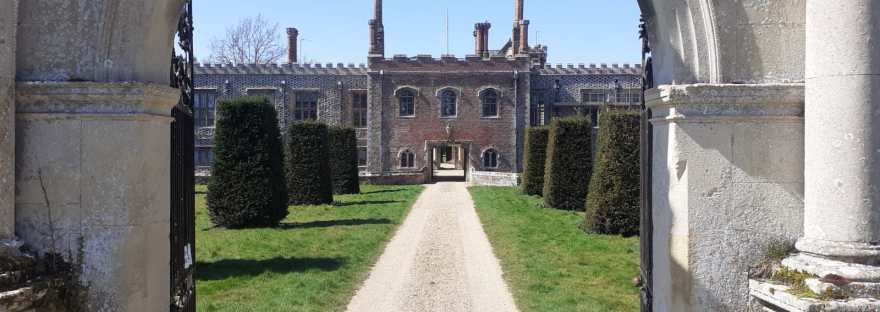
Aside from a passing reference to the old gamekeeper in Hunstanton park who was a bit Lady Chatterley in the way he hung huge panties on his clothesline outside his cottage in the woods the most significant literary reference to Old Hunstanton is that PG Wodehouse stayed there whilst writing several of his novels. For example, the series about Blandings castle that featured the pig called the Empress of Blandings which was inspired by a prize porker from the kitchen garden. He also wrote a story called Jeeves and the Impending Doom where he uses the Octagon( a shooting lodge used by one ancestor of the resident Le Strange family for practicing his violin) as the building where Bertie and a cabinet minister climb on to escape the wrath of a nesting swan.

 A gardener out of this world
Enjoyed thoroughly, entertaining and interesting.
LikeLike